
A Healthy Family Eating Guide for Mums of Gym-Going Teenagers and Wives of Men Trying to Lose Weight
1. Why Cooking Three Different Dinners Is Not the Answer
Why Most Meal Plans Fail Real Families
Cooking has always been one of the pleasures of being a wife and mother.
Not easy. I never said it was easy. But fulfilling. Alongside the tiredness, it gave you the feeling that you had done something right for the people you love. You had put good food on the table. You had taken care of your family.
Then, one day, the Gym appeared.
At first, it was a secret character in your son’s life. Then, with surprising speed, it began to make itself felt in everybody else’s life.
Your teenager started training and wanted to build muscle. He came home one evening and announced that he could no longer eat certain things because they did not fit his macros and might interfere with his gains. You were startled. Also proud.
You are the kind of mother who encourages her child when he finds something good and worth pursuing. So you said, sincerely:
“Wow! Bravo!!”
Then you looked with immeasurable sadness at several perfectly good dinners that had apparently vanished from the family repertoire overnight.
You tried to comply. A little clumsily. Still guessing what exactly you were supposed to cook now for this new goal. Still happy that your son has found something healthy that matters to him.
A week later, your husband suddenly noticed the weight he had been carrying for longer than he cared to admit and decided he wanted to lose it. He had tried before, occasionally. It had not always ended well. There may have been birthday cakes intended for sixteen people that somehow disappeared quietly, one slice at a time, in his general direction. You said nothing.
He did not know much about nutrition. There may have been a brief keto period, followed by the slightly selective conclusion that he should eat more meat and more fat. The part about eating less bread and pasta somehow got overlooked.
But now he was serious.
He wanted to do it. He believed he could.
You said nothing aloud.
Secretly, you knew that your teenager’s Gym had reached him, too, from a distance. Perhaps that was not a bad thing.
And yes, the Gym had reached you as well. You wanted to eat a little more healthily. Perhaps sit down with everybody. Perhaps enjoy your own dinner while it is still warm.
None of this sounded unreasonable.
Then cooking changed.
One family meal became three separate dinners overnight, then two when you got tired and started to improvise your own. Ingredients multiplied. The fridge filled with ingredients for three different dinners. You started thinking about dinner before you got out of bed and kept thinking about it after everybody else had eaten.
You wanted your husband to succeed this time.
But somehow, the more effort you put in, the more you felt you were failing.
And somewhere between the second saucepan and the reheated plate, the family meal began to disappear.
Most meal plans are built around one person, one goal and one set of portions. Families rarely work that way.
Different needs around the table are not a theory.
Three separate dinners do not solve the problem.
Can one meal work for muscle gain, fat loss and healthy eating?
Yes. Start with one shared meal, then build each plate around the person eating it.
Choose a shared protein base, but vary the amount.
Serve more or less carbohydrate according to energy needs.
Bring vegetables and other micronutrient-rich foods onto every plate.
Add or reduce fats and extras depending on the goal and the day.
You are still serving one meal. Each plate just needs to work for the person eating it. Read further, there’s more you need to know though.

2. Energy Balance for Families, Explained Simply
Why Fat Loss, Muscle Gain, and Maintenance All Start From the Same Place
Once the Gym enters the family, dinner suddenly comes with NUMBERS attached.
CALORIES… PROTEIN!!!… CARBOHYDRATES … STEPS… TRAINING days… REST days… Somewhere, somebody has opened an app and is entering the Pasta Gram by Gram.
The useful part is simpler: our body uses energy all day, even when you are doing nothing particularly impressive: breathing… Circulating blood. Keeping your organs working. Maintaining body temperature. That baseline is your basal metabolic rate, or BMR.
Then life adds the rest: walking to school. Going to work. Training. Carrying shopping bags. Taking the stairs because the lift is taking too long. Standing in the kitchen while everybody asks what is for dinner, despite being able to see that dinner is clearly happening.
Nutrition people call much of that everyday movement NEAT, or Non-Exercise Activity Thermogenesis (yeah, I LOVE capital letters!). Digestion uses energy, too. This is called The Thermic Effect of Food (yeah, capitals on me again! 🙂 ), or TEF. Add everything together, and you get your Total Daily Energy Expenditure, or TDEE. Put simply, your TDEE is the amount of energy your body uses across the day.
And there they are: BMR, NEAT, TEF and TDEE. That is enough acronyms for one dinner.
If your teenager eats a little more energy than he uses, he is in a calorie surplus. Combined with resistance training, enough protein and recovery, that can support muscle growth.
If your husband eats a little less energy than he uses, he is in a calorie deficit. Over time, that supports fat loss.
If you eat roughly the amount your body uses, you are around maintenance.
Three goals. One principle.
The mistake is assuming that everyone needs the same amount just because everyone is eating the same dinner.
They don’t.
Your teenager is still growing and training. Your husband may spend much of the day at a desk and wants to lose weight steadily. You may want a balanced dinner that supports your health and gets you through the evening without sending you back to the kitchen.
Your plates should not be identical.
You also do not need to calculate every calorie before serving dinner. I know you did it. Confession time: I have done it too. For now, the logic matters more than precision.
The family can share the same meal while each person eats the amount that suits their body, activity, and goals.
3. Muscle Growth Nutrition: What Teenagers and Active Adults Actually Need
Why Muscle Gain Needs Energy, Not Just Protein
By now, the Gym has made itself at home in the family. Protein intake has become a subject of great importance.
Your teenager starts training. Then he starts reading labels. Then chicken, rice, and broccoli appear so often that dinner begins to narrow in on them.
We have lived the phase.
It lasted long enough in our kitchen that we could have claimed a household record. Narrow dinners. We won!
Muscle growth has a name: hypertrophy. It happens when resistance training gives the muscles a reason to adapt, and the body has enough resources to respond.
The training part matters. If your teenager lifts the same weight in the same way forever, his body has very little reason to build more muscle. Progressive overload means gradually asking more of the muscles over time. A little more weight. Another repetition. Better control. A more demanding variation of the exercise. His body notices the extra work and adapts.
Protein helps with rebuilding.
Like the rest of us, your teenager digests dietary protein into amino acids. Those amino acids support muscle protein synthesis, the process through which the body repairs and builds muscle tissue after training.
You may also hear about the leucine threshold. Leucine is one of the essential amino acids found in protein-rich foods. When a meal contains a good serving of protein, it usually provides enough leucine to signal an increase in muscle protein synthesis. Chicken, fish, eggs, dairy foods, lean meat, and whey protein are natural sources. Plant proteins also contribute, although the amount and amino acid profile can vary from one food to another.
Then there is the mTOR pathway. This is one of the signalling systems inside the body that helps regulate muscle growth. Resistance training activates it. Leucine helps activate it, too. When training, dietary protein and sufficient total energy work together, the body is in a better position to repair and build muscle tissue.
The names sound more intimidating than the dinner you need to cook. A varied diet with regular servings of protein across the day usually does much of the practical work. Eggs at breakfast. Greek yoghurt after training. Chicken, fish, beans, lentils, tofu or lean meat at dinner. Whey protein can be convenient too, but it does not need to become the centre of family life.
But protein cannot do the whole job alone.
Your teenager needs enough total energy, too. He is training, studying, moving through the day and still growing. If he eats too little, recovery gets harder, and muscle growth has less to work with. A small calorie surplus can help. Small matters. We are supporting progress, not preparing him for winter.
Carbohydrates belong on the plate as well. They help replenish glycogen after training and provide him with energy for the next session. Removing them because somebody online declared war on pasta does not make the meal more serious. It usually makes the next workout worse.
And recovery still includes sleep.
Post-workout nutrition can stay simple. A normal meal. Greek yoghurt with fruit. Eggs on toast. A sandwich made with chicken left over from dinner. Let him choose between a few sensible options and learn what supports his training without letting the whole kitchen revolve around it.
A teenager is more likely to keep a healthy habit when dinner still looks like dinner.
The Gym may stay.
Chicken, rice and broccoli do not need to become permanent residents.
4. How to Lose Fat Without Eating Separately
Why Family Meals Can Still Work for Weight Loss
Your husband does not need a separate diet dinner.
He needs to eat a little less energy than his body uses over time. That is a calorie deficit. The word little matters more than most people think.
He may approach the new plan with great conviction. He may also confuse a calorie deficit with a calorie surplus from time to time, usually somewhere around the second helping.
You want to support him seriously.
A dramatic deficit can look impressively serious for a few days. Then hunger catches up with him.
A moderate deficit is more likely to survive ordinary life. Your husband still needs a plate that looks like dinner, fills him up and leaves him able to walk past the kitchen later without opening the biscuit cupboard again.
This is where satiety matters. Satiety is the feeling that a meal has properly fed you and that you are not immediately looking for something else. Protein helps. Dietary fibre helps too. Vegetables, beans, lentils, fruit, potatoes and whole grains add volume and staying power without packing every forkful with calories.
The idea is sometimes called volumetrics. Foods have different calorie densities. Some pack a lot of energy into a small amount. Others let you build a fuller plate for fewer calories. You do not need to turn dinner into a bowl of lettuce that leaves him hungry an hour later. You need a meal that fills him up without packing too many calories onto the plate.
Hunger also has chemistry behind it.
The first time I heard the words “ghrelin” and “leptin,” I assumed they had something to do with gremlins. Possibly the ones responsible for my chocolate-eating after everybody else had gone to bed.
They are hormones involved in appetite regulation. Ghrelin tends to rise when you are hungry and encourages you to eat. Leptin helps signal longer-term energy availability to the brain. Neither behaves like a simple on-off switch, which is partly why “just use more willpower” is such unhelpful advice.
Insulin response matters too. When you eat carbohydrates, your pancreas releases insulin, a hormone that helps move glucose from the bloodstream into your cells, where it can be used for energy or stored for later. Pairing carbohydrates with protein, fibre and ordinary whole foods can make the rise in blood glucose more gradual and help the meal feel steadier and more satisfying.
Then look at the kitchen.
If biscuits, crisps and chocolate are always the easiest things to reach, tiredness will notice. If fruit, yoghurt, eggs, and fibre-rich foods are ready to use, those choices become easier, too.
This is also where a few small mistakes families make around dinner can make fat loss much harder than it needs to be.
Your husband can definitely lose fat and still eat the same dinner as the rest of the family.
5. What Healthy Eating Really Means for a Family
It Is Not About Making Every Meal Perfect
Healthy eating becomes tiring when every plate feels like an exam.
Protein. Fibre. Five colours of vegetables. The correct fat. The approved seed selection. A sprig of something green placed at an angle, apparently for moral support. Spend too long online and even ordinary yoghurt starts to feel not quite good enough.
I really don’t think a family should live like that.
A healthy dinner can be simple. Fish with potatoes and salad. Lentil curry with rice. Chicken with roasted vegetables. Pasta with tomatoes, courgettes and a decent sauce. Some meals will be carefully planned. Some will be built from leftovers, frozen peas and whatever needs rescuing from the fridge.
Macronutrients are the nutrients your body needs in larger amounts: protein, carbohydrates and fats. They provide energy, support muscle, help you stay full and help your body get through the ordinary work of being alive.
Micronutrients are vitamins and minerals. You need them in smaller amounts, but smaller does not mean optional. Iron helps carry oxygen around the body. Calcium supports bones and teeth. Vitamin D helps the body absorb calcium and supports muscle function and the immune system.
And no, chocolate is NOT a micronutrient. Not even when it contains caramel. Although I believed otherwise for a while. With conviction.
Then there are antioxidants. These are substances found in foods such as fruit, vegetables, beans, nuts and whole grains. They help protect cells from damage caused by unstable molecules called free radicals. You do not need to memorise the chemistry before dinner. You do need to keep eating your vegetables.
Omega-3 fatty acids matter too. They are found in oily fish, walnuts, flaxseeds and some other foods. They support heart and brain health.
Fibre matters for digestion, fullness and steadier blood sugar regulation. It is a part of plant foods that your body does not fully digest.
You do not need to check every plate for all of this.
A varied week does much of the work.
That is one reason a Mediterranean-style diet makes sense for family life. It gives plenty of room to vegetables, fruit, beans, lentils, whole grains, fish, olive oil and ordinary meals cooked from familiar ingredients. It also leaves room for convenience food. Some evenings will contain more beige than green. The family will be fine, I promise.
Healthy eating does not need to become “clean eating”, with every ordinary ingredient placed under suspicion. Your teenager has probably already read the label. Twice.
Whole and minimally processed foods deserve plenty of space in the week because they make nutrient density easier to achieve. In simple terms, they give your body more useful nutrients for the energy they contain.
But “healthy” should not become another list of rules you have to think about at dinner.
Feed the family well, Most Of The Time.
Then sit down and eat.
6. Why Protein Matters for Muscle Gain, Fat Loss, and Healthy Eating
The Anchor Nutrient That Helps One Family Dinner Work for Everyone
Protein is the most useful nutrient to get right first when one family meal has to serve three different goals.
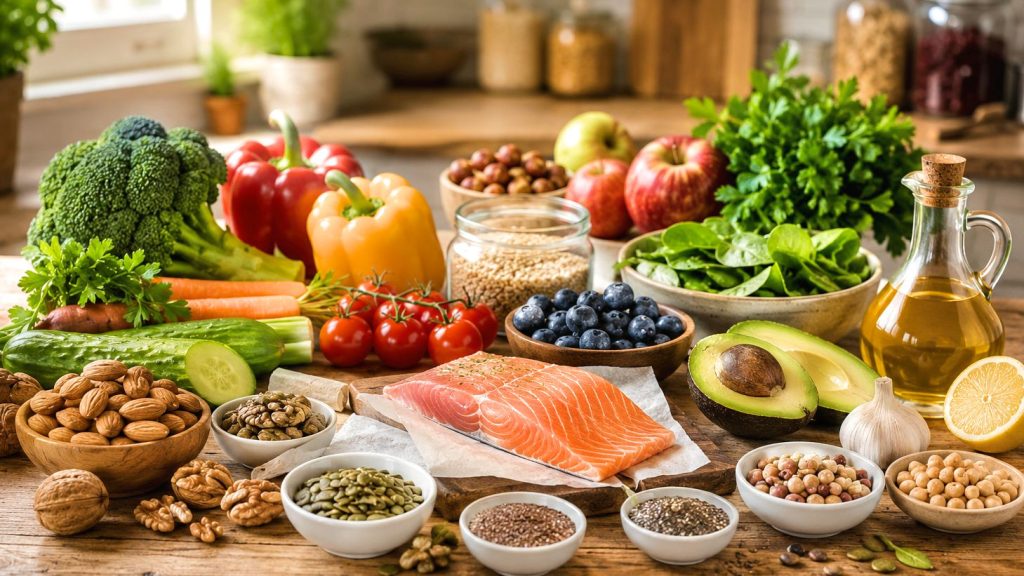
Choose the protein first, and the rest of the meal becomes easier to organise. Chicken. Fish. Eggs. Greek yoghurt. Lean mince. Beans. Lentils. Cottage cheese. You know the options by now. Choose food your family actually eats, not food bought with great optimism and left untouched until Friday evening.
Your teenager needs protein because he is training and trying to build muscle. Your husband needs it too. When he is eating in a calorie deficit, enough dietary protein helps him stay full and preserve muscle while he loses fat.
And you need it too. A dinner high in protein is more likely to keep you out of the cupboards later.
Protein gives the meal a centre. The rest can build around it.
Your body breaks dietary protein down into amino acids. Some of them are called essential amino acids because the body cannot make them on its own. You need to get them from food. Complete proteins contain all nine essential amino acids in useful amounts. Eggs, dairy foods, fish and meat are examples. Many plant proteins contribute well too. Beans, lentils, chickpeas, nuts and seeds all belong in a balanced diet. You can combine different plant foods across the day. Dinner does not need to become a chemistry practical.
Lean protein sources can be especially helpful when your husband wants to lose fat, because they add protein without adding too much extra energy to the plate.
Whey protein can be convenient as well. We know this because we own shaker bottles and drink protein shakes. Although it’s the teenager who goes to the Gym. Much of our training still takes place in our heads. The shakes remain useful.
Protein timing matters, but it does not need to become another family spreadsheet. Spread protein across the day. Breakfast. Lunch. A snack after training. Dinner. One large chicken breast at dinner cannot make up for a day with very little protein.
You may also come across protein targets expressed in grams per kilogram of body weight. They are useful when someone wants more precision. They do not need to take over dinner. For everyday family dinners, start with the simpler habit.
Protein is the easiest place to begin. It helps each of you for a different reason. And there is no need to eat three separate dinners each evening.
7. The Simple Portion Formula That Makes One Meal Work
How to Adjust Portions When Your Teenager Wants to Build Muscle, Your Husband Wants to Lose Weight, and You Just Want a Normal, Healthy Dinner
By now, you know why the plates cannot all look the same.
Your teenager is training and still growing. Your husband wants to lose fat without spending the evening thinking about food. You want a balanced dinner that supports your health and doesn’t require another round of calculations before anyone is allowed to eat.
The useful question is simple:
How much should go on each plate?
You can begin with the plate method. Look at the meal in parts: protein, carbohydrates, vegetables and any fats or extras. Then change the amounts according to the person, the day and the goal.
Your hand gives you a practical starting point.
For many adults, a palm-sized portion of protein works well as a rough guide. A fist-sized serving of carbohydrates gives you somewhere to begin. Add a couple of handfuls of vegetables. Then adjust for the person, the day and the appetite.
As a rough starting point, your teenager may need a larger protein serving and one or two fists of carbohydrates after training. Your husband may do better with a palm-sized protein portion, a smaller carbohydrate serving and plenty of vegetables. Your own plate may sit somewhere in between, depending on your appetite and your day.
That is calorie adjustment in practice. Change the serving size, not the meal.
Macro adjustment goes one step further. You may increase or reduce the amounts of protein, carbohydrates, or fat according to appetite, activity, and goals. Nothing dramatic: a little more here, a little less there… .
A food scale can help when you want more precision or when you are still learning what a portion looks like. We use one sometimes.
Not every evening. Some nights, the scale stays in the drawer.
Most family dinners do not need exact measurements. They need a quick visual check before the plates leave the kitchen.
Once you can see the differences, cooking a single dinner that accommodates them all becomes much easier.
That is where the Base + Booster method comes in.
8. Cook Once, Serve Three Ways: The Base + Booster Method
By now, you have earned the right to make dinner easier. No need to make it joyless.
You are cooking one family meal, not running a made-to-order kitchen. Leave enough room for each plate to work a little differently.
The Base:
The base is the shared part of the dinner. The food that everybody can eat and still recognise as dinner.
It may be a chicken tray bake with roasted vegetables and crisp-edged potatoes. A lentil curry. Turkey bolognese. Salmon with salad and brown rice. A stew simmering on the hob. Even lasagne.
The lasagne has not been banned. It never was.
A good base often includes a lean protein, vegetables, a carbohydrate source and some healthy fats from foods such as olive oil, nuts or seeds. Sometimes they arrive together in one dish. Sometimes serving a few components separately makes life easier.
Carbohydrates are often the simplest part to place on the table separately: rice, potatoes, pasta, bread, grains or flatbreads. You may also come across the term “complex carbohydrates.” These are carbohydrate-rich foods that often bring more fibre and take longer to digest than simple carbohydrates, such as sugar, sweets and sugary drinks. Oats, beans, wholegrain bread, brown rice, wholegrain pasta and potatoes are common examples.
The Boosters:
Boosters are the extras you intentionally add for the person eating the plate.
Your teenager may need more energy after training: extra rice, another potato, bread, a larger serving of chicken, Greek yoghurt or a little olive oil. Your husband may do better with more roasted vegetables, a fibre-rich side, perhaps some beans or lentils, and fewer energy-dense add-ons such as extra oil, cheese or another bread roll. You may want a balanced plate of your own, rather than the remains of everybody else’s dinner assembled near the kitchen counter.
Some boosters are almost effortless. Others are worth cooking.
A tray of garlicky greens. Roast carrots with herbs. A yoghurt sauce. A warm side dish your family genuinely likes. The method reduces unnecessary work and still leaves room for interesting food.
Build-your-own dinners can help, too. Burrito bowls. Wraps. Baked potatoes with toppings. Stir-fries with rice or noodles served separately. Everybody starts from the same food, then finishes the plate in a way that suits them.
That is flexible meal planning.
Use it when it makes dinner easier. Leave it alone when the meal already works.
And yes, the lasagne can stay.
9. How to Shop for a Family with Mixed Nutrition Goals
And What to Keep in the Kitchen So Cooking Is Easier on Busy Nights
You do not need to do three different weekly shops. You have probably worked that out by now.
You need ingredients that can show up in more than one dinner and still be useful.
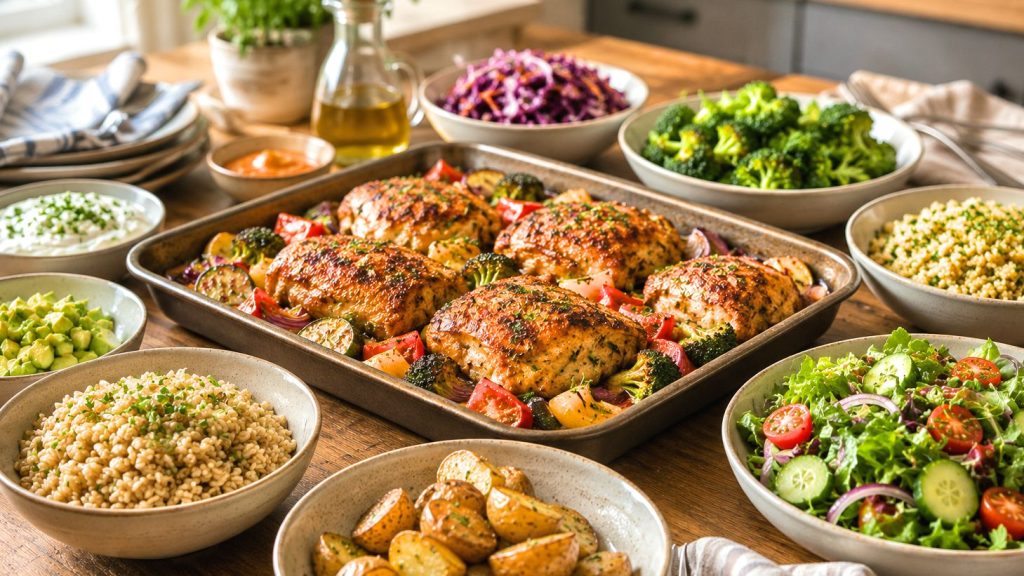
Start with protein. Chicken breast. Chicken thighs. Eggs. Tinned tuna. Greek yoghurt. Lean mince. Cottage cheese. Beans. Lentils. Frozen fish. You do not need all of them every week. Choose the ones your family will actually eat, then look at the cost per serving rather than the promises on the packaging.
Your teenager will probably inspect the label anyway and deliver a verdict on words you only recently learned yourself.
Add flexible carbohydrate staples: rice, potatoes, pasta, oats, bread and wraps. Wholegrain versions can provide more fibre where it suits the meal. Keep vegetables easy to use as well. Frozen peas. Broccoli. Spinach. Mixed vegetables. Salad leaves. Tomatoes. Whatever is seasonal, affordable and likely to make it onto a plate before the week ends.
A normal Tesco or Sainsbury’s shop already gives you most of what you need for a balanced week: ordinary protein, carbohydrate staples, vegetables, fruit, yoghurt, nuts and a few boosters for the meals ahead.<sup>2</sup>
Then look at what stays within reach once the shopping is unpacked.
Biscuits, crisps, chocolate, and, you know, the occasional birthday cake intended for sixteen people are very easy to notice when you are tired or hungry. Keep fruit, yoghurt, eggs, nuts and ready-to-use vegetables where you can see them and reach them before the biscuits.
We solved the problem of keeping too many sweets in the kitchen.
We moved them to the bedroom.
Please do not follow this example.
Stock the kitchen for the evenings you have, not the imaginary ones where everybody has time, energy and excellent judgement.
10. 10 Dinners You Can Serve Three Different Ways
One Recipe, Three Plates: Muscle Gain, Fat Loss, or Everyday Healthy Eating
The same method works across very different dinners.
You can still cook food with colour, texture, sauce, herbs, crisp edges and the occasional generous spoonful of parmesan. The method gives dinner a simple structure while leaving the menu wide open.
1. Chicken tray bake
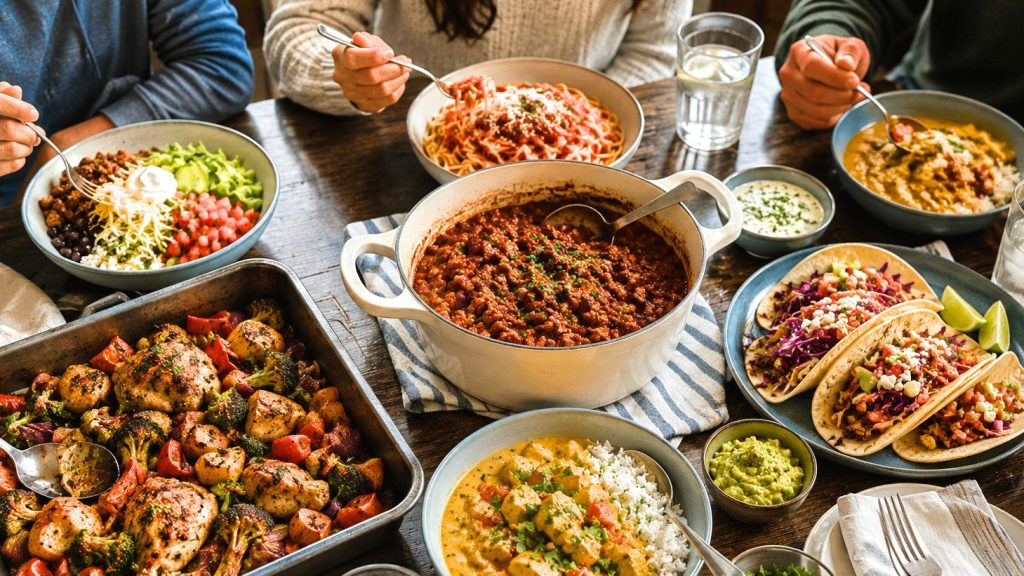
Roast chicken with crisp-edged potatoes, sweet peppers and courgettes catching a little colour. Add more potatoes and perhaps another piece of chicken for your teenager. Give your husband more vegetables and a smaller portion of potatoes. Take the middle ground for yourself, preferably before the crisp potatoes disappear.
2. Turkey bolognese
Make a rich tomato sauce with turkey mince, garlic and herbs. Your teenager gets a generous pasta bowl with extra sauce. Your husband takes less pasta, plenty of bolognese and a side salad. You keep the classic version, preferably while still hot.
3. Stir-fry
Cook chicken, tofu or prawns with peppers, broccoli and spring onions, still bright and slightly crisp. Serve rice or noodles separately. Add more for your teenager after training. Use a smaller portion for your husband and keep the vegetables generous.
4. Burrito bowls
Put warm rice, lean mince or beans, lettuce, tomatoes, peppers, salsa, Greek yoghurt and grated cheese on the table. Your teenager builds the larger bowl. Your husband goes lighter on the rice and keeps the protein generous. He may notice. We trust the marriage will survive.
5. Salmon with roast vegetables
Serve a salmon fillet with lemon, black pepper and vegetables roasted until the edges caramelise. Add quinoa, brown rice or potatoes. Your teenager may need a larger portion of carbohydrates. Your husband may want less. Nobody loses the salmon.
6. Lentil curry
Cook lentils with tomatoes, spices and enough warmth to make the kitchen smell as though you planned the evening properly. Put rice, Greek yoghurt and flatbreads on the table. Add more carbohydrates for your teenager. Give your husband more curry and a smaller serving of rice. Let your appetite decide your own plate.
7. Pasta bowls
Toss pasta with roasted vegetables, tomato sauce and a little parmesan. Keep grilled chicken, beans or lentils nearby. Your teenager gets the fuller bowl with an extra protein topping. Your husband eats more vegetables and a smaller portion of pasta. Take the bowl that suits you.
8. Baked cod
Bake cod with cherry tomatoes, herbs and olive oil until it flakes under the fork. Serve it with sweet potato wedges and green vegetables. Add bread for your teenager if he needs more fuel. Your husband may leave it alone. The cod remains exactly the same.
9. Egg fried rice bowls
Use leftover rice, eggs, peas, spring onions and whatever vegetables need rescuing from the fridge before they begin a new life of their own. Add another egg or more rice for your teenager. Give your husband more vegetables and less rice. Choose the bowl that suits your day.
10. Build-your-own wraps
Put warm chicken, hummus, Greek yoghurt, salad, chopped vegetables and wraps on the table. Let everybody assemble their own dinner. Your teenager adds more filling. Your husband keeps his wrap lighter. You sit down before someone asks whether there is anything else.
The food stays varied. The cooking stays enjoyable.
Dinner still belongs to the whole family.
11. How to Build a Weekly Family Meal System
A Working Meal Routine When Everyone Needs Something Different
You do not need seven new dinner ideas every week.
You need a few meal formats you can return to without having to make dinner from scratch every evening.
Choose three that work well in your house and keep them in rotation. Perhaps a tray bake, a pasta bowl and a build-your-own dinner.
A tray bake can appear on Monday with chicken and potatoes, then return later in the week with salmon and roasted vegetables. A pasta bowl may use turkey bolognese one evening and lentils with tomato sauce another. A build-your-own dinner can mean wraps, burrito bowls or baked potatoes with toppings.
The format stays familiar. The food doesn’t.
Start there. Then, whenever you have the time or the appetite for something different, replace one of the familiar dinners with an old favourite, a new recipe or a dish from another cuisine. The rotation gives you something to fall back on and leaves room for everything else.
This reduces decision fatigue. You stop trying to solve the same problem from scratch when everybody is already hungry, and nobody has become less particular.
Then batch-cook the protein.
Cook it with the next meals already in mind.
Prepare enough for two, three or even more meals, depending on the week. A larger tray of chicken breast. A proper batch of turkey mince. Lentils for tonight’s curry and another meal later. Some portions go into the fridge. Others go into the freezer.
Your teenager is committed to the Gym and has developed a serious attachment to chicken breast.
Your husband clearly prefers chicken thighs, which are rather more substantial and, in his view, fully deserving of their place in family life.
The compromise comes from alternating the chicken breast preferred by the Gym, pardon, by your teenager, with the plumper chicken thighs preferred by your husband. Although some days you may find yourself thinking that eating a little more vegetarian food from now on would be quite a good idea.
A little prep helps, too. Cook rice. Roast potatoes. Wash vegetables. Keep wraps and yoghurt ready to use. Write the three dinner formats in a weekly meal planner and decide which protein to cook in a batch.
Enough planning to help. Not enough to spend Sunday afternoon transferring food into seventeen matching containers. Nobody needs that.
Keep one emergency dinner in the freezer. It is proof that somebody in the house planned for reality.
Dinner does not need to begin from zero every time.
Give tomorrow’s dinner a head start. You will thank me.
12. Before You Try to Make One Meal Work for Everyone…
Why Knowledge Is Not Always Enough
By now, you understand the method. But knowledge is not always enough.
A few details can make or break dinner. They are easy to overlook at first, especially when you are trying to support your teenager, help your husband lose weight and still feed yourself properly.
Some are practical. Some are about appetite. Some are about knowing when to change the meal and when to leave it alone.
Because a system can become too strict as well.
Some evenings, dinner is pizza. The family will survive. The system should too. Your teenager may still inspect the toppings for protein. Your husband may decide that one fewer slice counts as a strategy. You are allowed to eat yours while it is still hot.
We learned some of this while working things out in our own kitchen. We also made quite a few of the mistakes families make when trying to make one meal work for everyone ourselves.
But there is another layer.
Some of the details that matter most are easy to miss until you know where to look. They are subtle. They are science-backed. And they can make the difference between a method that looks good on paper and a dinner routine that genuinely works in your kitchen.
That is why I put together a Free Guide:
What You Need to Know Before You Try to Make One Meal Work for Everyone
The subtle, science-backed secrets that can make or break dinner when your teenager wants to build muscle, your husband wants to lose weight, and you just want a normal, healthy dinner.
It is the guide I would have wanted before we worked all of this out in our own kitchen.
And no, nobody is taking pizza away from you. Not ever.