
What Goes Wrong When Your Teenager Wants to Build Muscle, Your Husband Wants to Lose Weight, and You Just Want a Peaceful, Healthy Dinner

Mistake 1: Assuming Different Goals Need Different Dinners
When the Gym first entered family life through your son, you probably had three mixed reactions: mild panic, complete delight for him, and then panic again.
You noticed that he was becoming more serious about it. This was not quite what you had secretly assumed on the first day: a passing enthusiasm that would disappear once the novelty wore off.
No. Not at all.
What you could not have anticipated was the way the Gym would begin to affect everybody else’s life, creating a new nutritional order around dinner.
Perfectly ordinary meals began to look slightly inadequate. Your teenager needed enough food to support training and growth. Your husband wanted to lose weight. You still wanted a peaceful, healthy dinner and, ideally, to eat it at the same time as everybody else.
The different energy needs were real.
The extra dinners were not inevitable.
But when you are trying to help, separate meals can feel like evidence that you are taking everybody seriously. You cook something higher in protein for your teenager. Something lighter for your husband. Your own dinner becomes whatever can be assembled after the important plates have left the kitchen.
That is when concern starts generating cookware.
One extra saucepan appears. Then a separate tray. A small bowl joins them for reasons that seemed completely reasonable when you began. Before long, you are carrying more of the mental load, spending more at the supermarket, and watching the shared family dinner turn into eating in shifts.
What to Do When This Happens
Pause before adding another dish.
Breathe.
Look for the part of dinner everybody can share, then change only what genuinely needs changing on each plate. A little more rice after training. A smaller serving of pasta alongside more vegetables. An extra side where it helps.
The practical answer is learning to make one meal work for different nutrition goals without having to rebuild dinner every evening.
Different goals change the plates. They do not automatically require different dinners.
What Not to Do
Do not buy another pot. Or pan. Or anything else with a handle.
Secret: We did this. It DID NOT work.
Sometimes it only proves that you now own one saucepan too many.
Mistake 2: Letting Protein Take Over the Dinner Table
What is the most frequently used word in the vocabulary of a teenager who has started going to the Gym?
You guessed it.
Macros!
And what is the second most frequently used word in the vocabulary of a teenager who is taking the Gym seriously?
You guessed it again.
Protein!
There is a good reason for the enthusiasm. Dietary protein provides the amino acids the body uses for muscle protein synthesis, the process of repairing and building muscle tissue after training.
But more is not automatically better.
When protein intake becomes the only thing anybody notices, the rest of dinner starts to shrink around it. Carbohydrates are treated as optional. Healthy fats are forgotten. Vegetables become a decorative afterthought. Fibre and micronutrients quietly disappear from the conversation.

And one very large portion of chicken at dinner does not make up for a day that contained almost no protein beforehand.
Protein distribution matters too. A reliable source at breakfast, lunch, after training and dinner usually makes more sense than asking one evening meal to carry the entire workload.
And more protein is not automatically harmless simply because it is associated with fitness. Excessive intake can create problems too, especially when it pushes variety off the plate or when someone already has a health condition that needs proper medical guidance.
What to Do When This Happens
Bring protein back into proportion.
Keep a dependable source in the day, not just at dinner. Then look at the whole plate again.
Carbohydrates still support training. They may even support your husband’s training, too, although his first session is currently scheduled for roughly eighteen months from now.
Healthy fats still matter. Vegetables, fibre and micronutrient-rich foods still need to turn up.
What Not to Do
Do not turn dinner into a protein target with side dishes.
Do not let every meal become a running commentary on grams.
Your teenager can care about his gains.
Dinner still needs to feed the whole family.
Mistake 3: Treating Carbs Like the Problem
“Mum! Too many carbs!”
You begin to hear this more and more often from your teenager.
And just like that, an entire macronutrient category begins to disappear from the table.
Carbohydrates are not the enemy.
This is worth saying plainly, especially when the person treating them as such is already extremely lean and training hard several times a week.
If anything, your husband may be the one who needs to look more carefully at portion size. Although this does not mean hiding the bread and retrieving it later in another form.
Carbohydrates still have a job to do.
They provide energy. Your body stores some of that energy as glycogen in the muscles and liver, ready to use when activity demands it. Training draws on those stores. A meal with rice, potatoes, pasta, bread or fruit can help restore them for the next session.
Your teenager may need more carbohydrate after training, not less. Your husband may need a smaller serving. You may want a portion that suits your appetite and the rest of your day.
That is not inconsistency.
That is the point.
The type matters too. Fibre-rich options such as oats, beans, wholegrain bread, wholegrain pasta and potatoes can make a meal more satisfying and help the rise in blood glucose feel steadier. Sweets and sugary drinks behave differently. They release glucose more quickly, leading to a sharper rise in blood sugar and insulin levels.
This does not mean refined flour or sugar must disappear forever.
What to Do When This Happens
Keep carbohydrates in the meal.
Adjust the portion and choose the type with a little more care.
Serve rice, pasta, potatoes or bread in a way that allows each person to take what suits them.
Test adjusted portions for a while. Look at what actually supports training, fat loss, appetite and an ordinary family dinner that still works.
What Not to Do
Do not remove an entire macronutrient category from dinner.
Do not treat every carbohydrate like refined white flour.
Even that has a place sometimes.
Mistake 4: Serving Identical Portions to Everyone
Identical portions can look fair at first.
Nobody receives special treatment. Nobody needs a separate plate.
But fairness is not the same as sameness.
Your teenager may finish dinner and still be hungry. Your husband may eat more than his goal requires simply because that is what landed on the plate.
And you, once again, end up with whatever is left because you have spent too much effort sorting everybody else out.
Different bodies, appetites and days need different amounts of food. One serving may support a calorie surplus. Another may suit maintenance. A smaller one may help create a calorie deficit without leaving somebody hungry again an hour later.
The mistake is easy to miss because nothing looks obviously wrong. The plates match. Dinner is on the table.
But the serving spoon does not know who trained, who spent the day at a desk or who forgot to eat lunch properly.

What to Do When This Happens
Serve the same dinner, but consider the person eating it before copying the same portion onto every plate.
Activity matters. Appetite matters. Body size matters. The rest of the day matters too.
If you need a practical starting point, the simple portion formula for one shared family meal provides a visual guide without turning dinner into arithmetic.
Then watch what happens for a while. Is somebody hungry again soon afterwards? Is one plate regularly too much? Does the serving size need a small adjustment?
What Not to Do
Do not assume that matching plates are automatically the right plates.
Do not let the serving spoon become too generous in one direction or too stingy in another.
And leftovers are not a plan for your dinner.
Mistake 5: Making the Weight-Loss Plate Too Small
A weight-loss plate can become very small very quickly.
A little less rice. A little less sauce. Perhaps less bread. Then less of the main dish as well, just to be safe.
By the time dinner reaches the table, your husband is looking at a plate that appears to have been assembled during a period of national shortage.
The problem is not that the meal is lighter.
The problem is that it no longer does the basic job of feeding him.
A calorie deficit should help with fat loss over time. It should not leave him hungry again before the washing-up is finished, and opening the cupboard where the biscuits lived until twenty minutes ago.
This is where satiety matters. Satiety is the feeling that a meal has properly fed you. Protein helps. Dietary fibre helps too. Vegetables, beans, lentils, potatoes, fruit and whole grains can make the plate more filling without pushing the calorie count too high.
Calorie density matters as well.
Some foods pack a lot of energy into a small amount. Others allow you to serve a fuller plate for fewer calories. This is the idea behind volumetrics: use more foods that bring volume, fibre and staying power.
It does not mean serving a large bowl of leaves and hoping for the best.
What to Do When This Happens
Make the plate lighter, not meagre.
Keep enough protein. Add vegetables and fibre-rich foods. Use lower-calorie-density foods to make dinner feel like dinner.
Then watch what happens afterwards.
If your husband is opening cupboards twenty minutes later, the answer is not automatically more discipline. The plate may need changing.
What Not to Do
Do not turn fat loss into a contest to see how little dinner can contain.
A weight-loss plate still needs to feed the person eating it.
Mistake 6: Ignoring the Foods Everyone Sees First
A kitchen can be full of good food and still fail at the exact moment somebody comes home hungry.
That is the part people miss.
Fruit may be in the bowl. Yoghurt may be in the fridge. Eggs may be somewhere behind the cheese. Vegetables may be waiting patiently in the bottom drawer.
But if all of those options need washing, peeling, chopping, cooking or locating, while the biscuits are already open, the biscuits are not facing serious competition.
Your teenager comes home after school or training and wants food.
Your husband opens the cupboard while deciding what he is “just checking”.
You may do the same after spending too much time feeding everybody else.
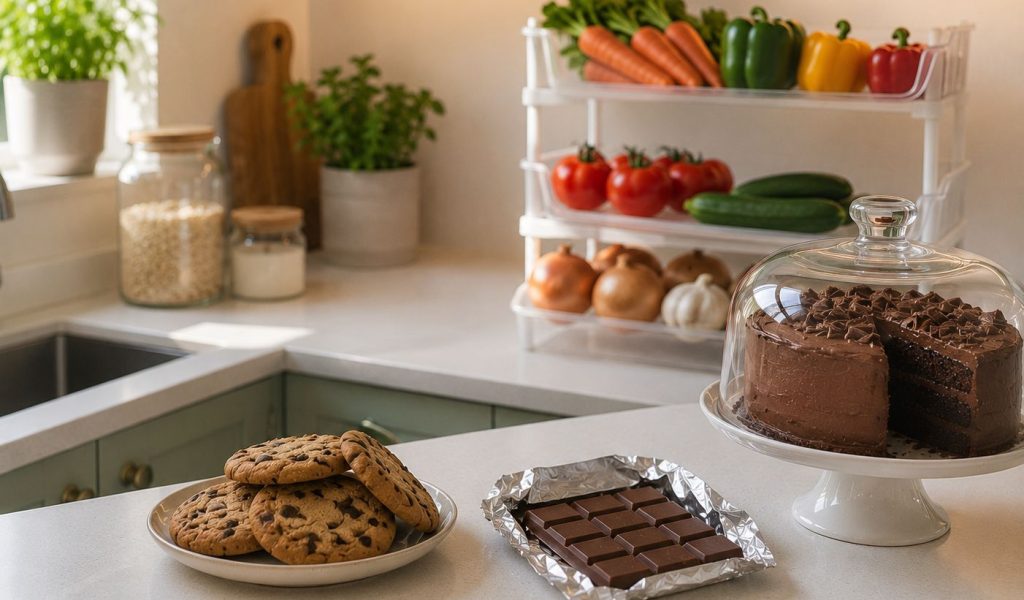
The problem is not that the kitchen contains sweets.
The problem is that the nourishing food is present in theory and inconvenient in practice.
What to Do When This Happens
Reduce the number of steps between hunger and the food you want everybody to eat more often.
Wash the fruit for the day.
Put the yoghurt where people can see it.
Keep a few vegetables ready to use.
Have one or two filling snacks that do not require another round of cooking.
We have bought vegetables with great plans for their future, only to forget to include them in any actual meals.
And:
HIDE THE CHOCOLATE!
What Not to Do
Do not congratulate yourself for buying vegetables and then leave them in the bottom drawer until they become an archaeological discovery.
Do not expect hungry people to choose the option that needs more work when the easiest food is already waiting.
And please:
DO NOT HIDE THE CHOCOLATE IN THE BEDROOM!
Mistake 7: Shopping for Ideal Evenings Instead of Real Ones
How can a weekly shop look excellent on Sunday and become half a disaster by Friday?
Very easily.
You buy fresh vegetables, fruit, chicken breast, eggs, Greek yoghurt and everything needed for several proper dinners. You may even have a plan.
Then the week begins.
Training finishes late. Your husband comes home hungry. You are tired before dinner has started. The meal you chose with complete confidence now requires chopping, cooking, and more patience than anyone in the house has right now.
The problem is not the healthy food.
The problem is that you assumed every evening would be perfect.
A realistic shop needs food for the harder evenings too. Tinned tuna. Beans. Frozen fish. Frozen vegetables. Rice, potatoes, pasta, bread and wraps. Meat already sliced, diced or portioned when that saves time. A few dinners in the freezer that your family genuinely likes.
Look at the cost per serving as well. Some foods make sense not because they look impressive, but because they are affordable, practical and likely to become dinner.
What to Do When This Happens
Shop for two kinds of evenings:
the one where you have time to cook;
and the one where dinner needs to happen quickly.
Keep a few easy combinations in mind. Chicken with potatoes and peas. Tuna pasta. Frozen fish with rice and vegetables. Wraps with whatever is ready.
And keep some dinners in the freezer for the evenings when cooking properly is no longer realistic.
We have been saved by the freezer more than once.
And by the occasional pizza.
What Not to Do
Do not fill the trolley with ingredients that all require time, chopping and goodwill at exactly the same moment.
Do not shop only for the week you hope to have.
Shop for the one that usually turns up.
Mistake 8: Tracking So Much That Dinner Gets Cold
Tracking can be helpful at first.
Your teenager learns what a portion of protein looks like. Your husband begins to notice where calories are coming from. You may use the food scale for a while and realise that your idea of “a little pasta” was rather more generous than you thought.
Somewhere along the way, the Gym finds a way to extend its influence through an app.
There is nothing wrong with calorie tracking or macro tracking when they help you learn.
The problem begins when every plate needs to be weighed, checked and logged before anybody can start eating.
Dinner is getting cold while somebody scrolls through MyFitnessPal looking for the yoghurt.
Tracking fatigue is real. So is the point where portion awareness starts turning into food anxiety, and the meal becomes another task on the list.

What to Do When This Happens
Use the numbers to learn.
Weigh a few familiar foods when it helps. Notice what a serving size looks like. Pay attention to protein, carbohydrates and fats for long enough to understand the pattern.
Then step back.
Keep the food scale for the days when precision is genuinely useful. Let ordinary dinners stay ordinary.
What Not to Do
Do not weigh every ingredient indefinitely.
Do not make the family wait while somebody searches for the exact yoghurt in MyFitnessPal.
Use tracking when it helps.
Put the phone down when it does not.
Mistake 9: Turning Healthy Eating Into a Purity Test
Healthy eating can become stricter than you meant it to be.
It usually begins with good intentions. You cook more often. You bring more vegetables, fibre and whole foods into the week.
Then, The Gym begins contributing opinions from a distance.
White bread needs explaining. A ready-made soup becomes questionable. Pizza comes with guilt attached. The phrase “clean eating” starts to sound less like a loose idea and more like a set of rules nobody remembers agreeing to.
We have done versions of this, too.
At some point, the rules stop helping. The meals become narrower. Ordinary food starts disappearing for no good reason. And the family begins to confuse restriction with health.
The problem is not caring about nutrient density. Whole and minimally processed foods deserve plenty of room in family life. A Mediterranean-style diet makes sense partly because it leaves room for vegetables, fruit, beans, lentils, whole grains, fish, olive oil, and ordinary meals people genuinely enjoy.
But a balanced diet is built over time.
It is not ruined by one relaxed dinner.
Some evenings, pizza is dinner.
What to Do When This Happens
Zoom out.
Look at the week, not one plate.
Keep the vegetables, fibre-rich foods and meals cooked from recognisable ingredients. Use convenience foods when they help. Let favourite foods remain favourite foods.
A family can eat well without eating perfectly.
What Not to Do
Do not attach guilt to pizza.
Do not treat one relaxed dinner as though it has undone the whole week.
Do not let “healthy” become another source of tension at the table.
Healthy eating should make family life better.
Not narrower.
Mistake 10: Solving Dinner From Scratch Every Evening
Some evenings need more thought than others.
But if every dinner begins with the same long list of decisions, the planning starts to wear you down before the cooking has even begun.
What are you making? Which protein needs to be used? What works after training? What will your husband eat? Do you have enough vegetables? Is there anything in the freezer? Did somebody finish the wraps without mentioning it?
This is decision fatigue.
None of the questions is especially difficult. The problem is having to answer all of them again and again.
A simple weekly menu can help. Not a rigid one. Just enough of a plan to give the week some shape.
Choose a few dinner formats you know work. Cook some proteins in larger batches for two, three or more meals. Decide what the leftovers are likely to become before they disappear into containers. Keep a few dinners in the freezer.
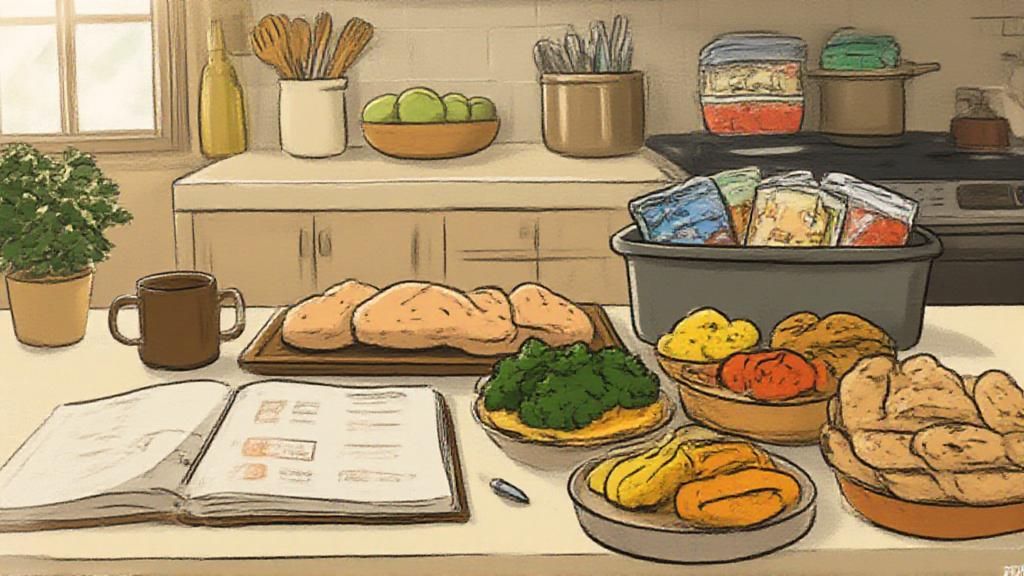
Then leave room for the meals you feel like cooking, the new recipe you want to try and the evening when pizza is clearly the right answer.
What to Do When This Happens
Use a weekly meal planner to reduce decision-making before the week begins.
Keep the plan flexible.
If dinner keeps becoming a new problem every evening, the practical system for making one meal work for different nutrition goals gives you a useful starting point.
What Not to Do
Do not make yourself decide everything again every evening.
Do not turn meal planning into another job with its own paperwork.
Routine should support family life.
It should not take it over.